


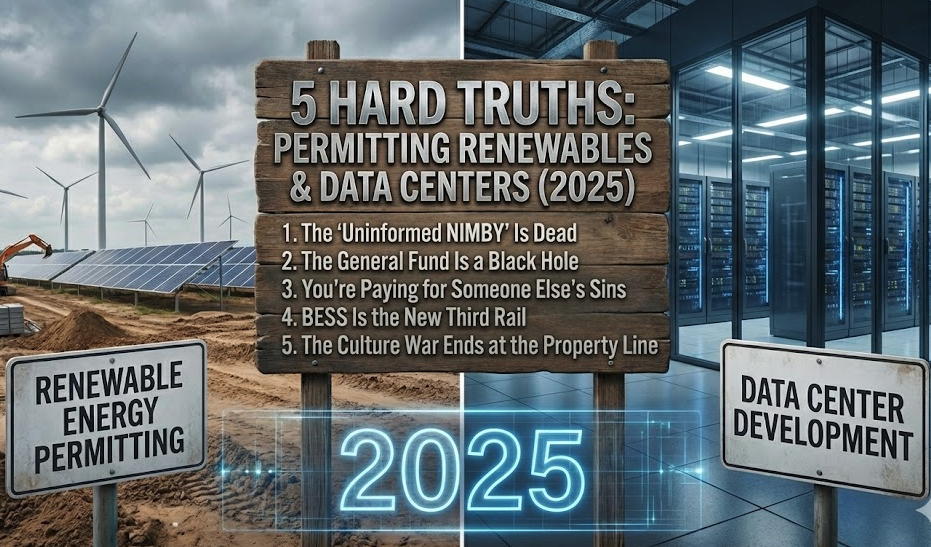
We conducted due diligence on approximately 12 GW of projects this year. Here is what we learned.
In 2025, Flypower delivered deep-dive due diligence reports for nearly 12 GW of utility-scale solar, wind, battery storage, and hyperscale data center projects across the country. We sat through hours of council meetings, combed through thousands of pages of news articles, and scanned through countless Facebook pages (or at least our AI did!).
When you look at that much data in aggregate, patterns emerge. We found that the old risks—environmental reviews and interconnection queues—are still there, but they are no longer the primary killers of projects. The decisive risks are human, emotional, and intensely local.
Here are the top 5 takeaways from our year in the trenches, and what developers need to know to win in 2026.
1. The “Uninformed NIMBY” is Dead
For years, developers viewed local opposition as an emotional hurdle to be managed with better communication. Our 2025 data shows that assumption is fatally wrong.
Today’s opposition isn’t carrying signs—it’s carrying wildfire modeling data, 8-page technical analyses of thermal runaway chemistry, and direct lines to state legislators. In one Great Plains county, a neighboring landowner with 30 years of energy investment experience submitted detailed fire risk analysis citing 60+ global BESS incidents over a decade—analysis that directly shaped commissioner deliberation. In a rural Southern Illinois county, a resident successfully escalated local enforcement failures—EPA violations, unrepaired road damage, screening gaps—directly to state legislators, bypassing the county board entirely. And in a Northern Virginia county, a resident group opposing a data center campus arrived at hearings with detailed noise modeling, stormwater calculations, and traffic projections—forcing the Planning Commission to table the application for additional technical review.
And in several cases, we found that opposition leaders aren’t just showing up to hearings—they’re sitting on the Planning Commission itself. In a rapidly growing Colorado county, a leader of a local opposition network held a seat on the body reviewing a solar application, ensuring the opposition’s narrative was baked into the regulatory record from day one.
The opposition isn’t just trying to move your project—they’re using the technical process to create a “Community Veto” that overrides even the most compliant applications. In a rapidly growing county in South Carolina, organized anti-overdevelopment networks successfully halted a project at the final incentives hearing—proving that a community veto can terminate a project even after it passes every administrative land-use test.
The Lesson: If you haven’t pre-negotiated with the technical gatekeepers—the Fire Chief, the Drainage Board, the County Engineer—your “perfect” application will be picked apart by a community that has spent months studying your technology’s specific failure points. Assume you are not the only expert in the room.
2. The General Fund is a Black Hole
For decades, the standard pitch was: “We will expand the tax base.” In 2025, that argument lost its power.
In economically distressed rural communities, residents view their local government’s General Fund as a “black hole” where revenue disappears into administrative deficits. In one eastern North Carolina county facing state takeover of its social services department and an $800K+ deficit, residents described the fiscal situation as a “four-alarm fire” and demanded that any new revenue be visibly tied to specific fixes—not generic promises. In a rural Southern Illinois county, the historic courthouse was literally crumbling—plaster falling on staff, rodents in the corridors—with no local funding path. Replacing it would cost nearly double the county’s entire annual budget.
The projects that succeeded in these environments didn’t promise millions to county coffers. They promised the EMS station that hasn’t been built, the dump sites that had to close three days a week or the ambulance that residents fear won’t come. In one Minnesota county, a developer successfully neutralized opposition by establishing a community benefit fund with local control that funded fire equipment and school technology annually—creating organizational advocates across the community.
The Lesson: In 2026, don’t pitch “tax revenue.” Pitch the specific line item your PILOT will fund. Quantify benefits in terms residents understand: not “millions in revenue” but “prevents a 3% property tax increase” or “funds two new ambulances.” Make the money visible.
3. You’re Paying for Someone Else’s Sins
No project exists in a vacuum. Across our research, we consistently found that opposition to new proposals wasn’t really about the new proposal—it was about the scars left by the previous developer.
In a rural Southern Illinois county, one operating solar project’s $750,000 in unrepaired road damage—still unresolved three years after construction—created intense scrutiny for all subsequent applicants. Board members explicitly referenced the old damage when questioning new applications. In the same county, a prior project’s EPA Clean Water Act violations ($175,000 federal settlement) and a fire incident created a “legacy of distrust” that shaped the reception for every subsequent developer, regardless of their track record.
The inheritance of blame extends across technology types. In one upstate New York county, a wind turbine fire—with fiberglass debris spread over roughly a mile and fire crews unable to safely respond—became the lens through which all subsequent battery storage proposals were evaluated. Residents assumed the same “let it burn” outcome would apply to BESS facilities, even though the technologies are entirely different.
The Lesson: Due diligence isn’t just checking the code; it’s understanding the community’s emotional history. Before you file, know: What project angered this town? What promises were broken? What infrastructure was damaged and never repaired? You will be asked to answer for sins you didn’t commit.
4. BESS is the New Third Rail
Battery storage has become the single most consequential variable in project approval. Across our 2025 research, we found solar-only projects sailing through hearings while proposals with storage components triggered organized, technically sophisticated opposition.
The pattern is striking. In one rural Idaho county, staff discovered that BESS facilities could be permitted by right—without any public hearing—and the commissioners enacted a moratorium within weeks. In Illinois, the state law that preempted local denial of solar explicitly did NOT cover battery storage, leaving BESS components subject to full local discretionary authority while the solar portion became near-automatic administrative approval.
Commissioners now arrive at hearings armed with specific incident data: the Arizona explosion in 2019, the thermal runaway events in California. In one Nebraska county, a commissioner cited “an incident in Arizona where a lithium battery storage facility overheated…resulting in several first responders being seriously injured” as direct justification for his skepticism. Fire chiefs testify that their volunteer departments—often staffed by members averaging 60+ years old—would have no choice but to establish a perimeter and “let it burn.”
The Lesson: In 2026, treat BESS as a separate permitting workstream with its own stakeholder map. Your fire safety strategy should be as detailed as your interconnection strategy. Co-develop pre-incident plans with first-due AND mutual-aid departments before your first hearing. Fund their training. Donate their equipment. If you can’t get the fire chief to validate your protocols on the record, assume your BESS will be conditioned out—or denied.
5. The Culture War Ends at the Property Line
We assumed conservative rural areas would be ideologically opposed to renewable energy. Our 2025 data proved us wrong.
In an upstate New York county, the Republican-dominated legislature passed a near-unanimous resolution opposing the state’s gas ban and formally endorsed federal legislation designed to block state energy mandates. The same body—often in the same meeting—has approved 100% of renewable energy PILOTs and road use agreements that met their financial benchmarks. The chairman of the local Republican Party voted YES on both the anti-mandate resolution AND a major wind farm PILOT. As one legislator put it, explaining her vote for the anti-gas-ban resolution: “I am all in favor of green energy, but I want a choice.” The ideology and the deal existed in the same room, in the same vote.
The pattern held across jurisdictions. In a rural Southern Illinois county, we analyzed 185 board votes and found that not a single member had ever expressed support for renewable energy or environmental benefits. Approvals stemmed entirely from property rights convictions—one member’s voting rationale was simply that “government agencies should not tell people what they can do with their property.”
The most effective testimony we found in the record came not from developers, but from multi-generational landowners. In a Wyoming hearing, a participating rancher testified: “If not for this project, the land would probably be sold to a developer for housing development and would leave the family forever.” That reframing—from “climate action” to “keeping the ranch in the family”—dissolved resistance that no amount of developer presentation could have overcome.
The Lesson: Stop debating climate change in Town Hall. Start treating the permit as a business transaction. Frame your project around landowner choice, property rights, and family succession—not green energy or state mandates. When the offer hits the county benchmark and the landowners speak in favor, the culture war often stays at the door.
Looking Ahead
If 2025 taught us anything, it’s that technical feasibility is the easy part. The hard part is navigating the trust gap.
As we head into 2026, the winners won’t just be the developers with the most robust interconnection positions. They’ll be the ones who understood the community’s history before they filed, who secured validation from the fire chief, the school superintendent, and the local business association before the hearing, and who framed the project in the community’s language—not the industry’s.